step_svmsmote() creates a specification of a recipe step that generate
new examples of the minority class near the decision boundary using the
support vectors of a fitted support vector machine.
Usage
step_svmsmote(
  recipe,
  ...,
  role = NA,
  trained = FALSE,
  column = NULL,
  over_ratio = 1,
  neighbors = 5,
  distance = "euclidean",
  m_neighbors = NULL,
  out_step = 0.5,
  indicator_column = NULL,
  skip = TRUE,
  seed = sample.int(10^5, 1),
  id = rand_id("svmsmote")
)
Arguments
- recipe
A recipe object. The step will be added to the sequence of operations for this recipe.
- ...
One or more selector functions to choose which variable is used to sample the data. See recipes::selections for more details. The selection should result in single factor variable. For the
tidymethod, these are not currently used.- role
Not used by this step since no new variables are created.
- trained
A logical to indicate if the quantities for preprocessing have been estimated.
- column
A character string of the variable name that will be populated (eventually) by the
...selectors.- over_ratio
A numeric value for the ratio of the minority-to-majority frequencies. The default value (1) means that all other levels are sampled up to have the same frequency as the most occurring level. A value of 0.5 would mean that the minority levels will have (at most) (approximately) half as many rows as the majority level.
A named numeric vector can be used instead to give different levels different targets, for example
c(a = 1, b = 0.5). The names must be levels of the outcome and the values are ratios of the majority level, exactly as in the single-number case. Levels that are not named are left untouched, as are rows with a missing outcome. Because a vector of targets is not a single value, supplying one means this argument can no longer be tuned. Seevignette("ratio", package = "themis")for more details.- neighbors
An integer. Number of nearest neighbor that are used to generate the new examples of the minority class.
- distance
A character string specifying the distance metric used for nearest neighbor calculations, defaulting to
"euclidean". The available metrics fall into three groups."euclidean","cosine", and"mahalanobis"use approximate nearest neighbors via the RANN package and scale well to large datasets."squared_chord","matusita","hellinger", and"bhattacharyya"are probability-divergence measures that treat each row as a distribution over the predictors, so they require non-negative values."hellinger"and"bhattacharyya"further require each row to sum to 1. All four also use the RANN package and scale well to large datasets."manhattan","chebyshev","canberra","soergel","lorentzian","jeffreys","topsoe","jensen-shannon","jensen_difference","taneja", and"kumar-johnson"compute an exact all-pairs distance matrix. This takes time and memory proportional to the square of the number of observations in a class, so these are best suited to smaller datasets. Everything from"canberra"onwards is a probability divergence requiring non-negative values, is provided by the philentropy package (which must be installed separately), and in the case of"jeffreys","taneja", and"kumar-johnson"requires strictly positive values, since those divide by individual predictor values.The probability divergences are meaningful for compositional predictors such as proportions or counts normalized per observation, and are generally not appropriate for standardized predictors.
- m_neighbors
An integer or
NULL. Number of nearest neighbors, among all classes, that are used to label each minority support vector as noise, danger, or safe. Defaults toNULL, which means2 * neighbors.- out_step
A number. Step size used when extrapolating new examples away from safe support vectors. Defaults to 0.5.
- indicator_column
A single string or
NULL(the default). If a string is given, a logical column with that name is added to the output, marking rows added by the step (TRUE) vs rows from the original data (FALSE).- skip
A logical. Should the step be skipped when the recipe is baked by
bake()? While all operations are baked whenprep()is run, some operations may not be able to be conducted on new data (e.g. processing the outcome variable(s)). Care should be taken when usingskip = TRUEas it may affect the computations for subsequent operations.- seed
An integer that will be used as the seed when applied.
- id
A character string that is unique to this step to identify it.
Value
An updated version of recipe with the new step
added to the sequence of existing steps (if any). For the
tidy method, a tibble with columns terms which is
the variable used to sample.
Details
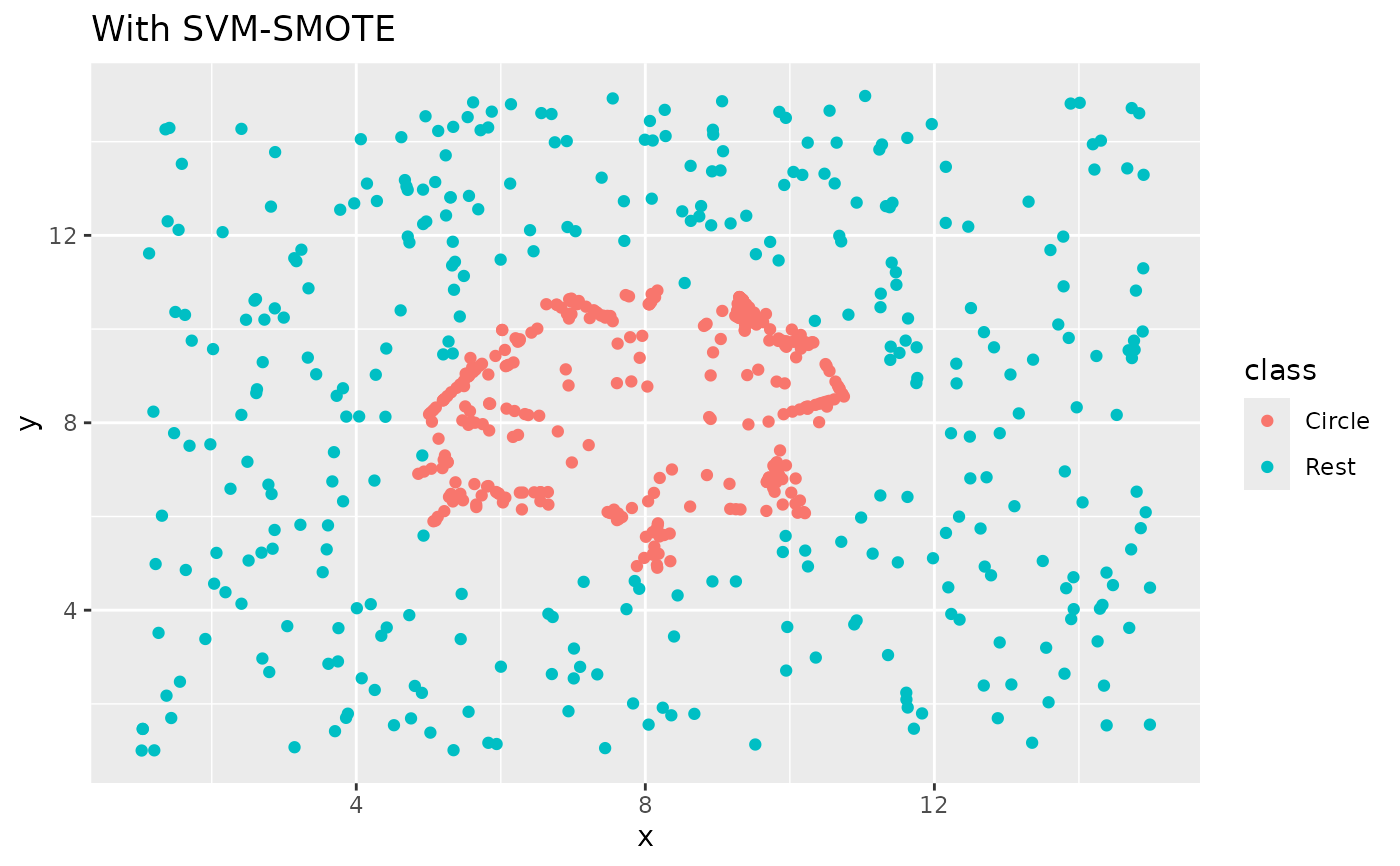
SVM-SMOTE (Support Vector Machine SMOTE) works the same way as SMOTE, except that instead of generating points around every point of the minority class, it focuses generation near the decision boundary. A support vector machine is fitted to the data and the support vectors that belong to the minority class are used as the base points for generating new examples.
For each minority support vector its nearest neighbors among all classes are calculated. If all of the neighbors come from a different class the support vector is labeled noise and is discarded. If more than half of the neighbors come from a different class the support vector is labeled "danger" and new points are interpolated between it and its minority-class neighbors. The remaining support vectors are considered to be in a safe region and new points are extrapolated away from their minority-class neighbors.
The number of neighbors used for this labeling is controlled by
m_neighbors, and how far the extrapolated points are placed is controlled by
out_step.
The support vector machine is always fitted with kernlab::ksvm() using a
radial basis function kernel (kernel = "rbfdot") and a cost of C = 1,
matching the reference implementations of the method. These are not exposed
as arguments because the fitted model is only used to identify which minority
observations are support vectors, and not for prediction, so the sampling
results are relatively insensitive to them.
SMOTE generates new examples of the minority class using nearest neighbors
of these cases. For each existing minority class example, new examples are
created by interpolating between the example and its nearest neighbors. The
number of nearest neighbors used is controlled by the number of neighbors
argument (k in smote(), neighbors in step_smote()), and the number
of new examples generated is controlled by over_ratio.
All columns in the data are sampled and returned by recipes::juice()
and recipes::bake().
All columns used in this step must be numeric with no missing data.
When used in modeling, users should strongly consider using the
option skip = TRUE so that the extra sampling is not
conducted outside of the training set.
Minimum observations
Each minority class must have at least neighbors + 1 observations to
perform the SVM-SMOTE algorithm.
Tidying
When you tidy() this step, a tibble is returned with
columns terms and id:
- terms
character, the selectors or variables selected
- id
character, id of this step
Tuning Parameters
This step has 3 tuning parameters:
over_ratio: Over-Sampling Ratio (type: double, default: 1)neighbors: # Nearest Neighbors (type: integer, default: 5)m_neighbors: # Nearest Neighbors (type: integer, default: NULL)
Case weights
The underlying operation does not allow for case weights. Supplying data with a case weights column to this step results in an error.
References
Nguyen, H. M., Cooper, E. W., and Kamei, K. (2011). Borderline over-sampling for imbalanced data classification. International Journal of Knowledge Engineering and Soft Data Paradigms, 3(1), 4-21.
See also
svmsmote() for direct implementation
Other Steps for over-sampling:
step_adasyn(),
step_bsmote(),
step_kmeans_smote(),
step_rose(),
step_smogn(),
step_smote(),
step_smoten(),
step_smotenc(),
step_upsample()
Examples
library(recipes)
library(modeldata)
data(hpc_data)
hpc_data0 <- hpc_data |>
select(-protocol, -day)
orig <- count(hpc_data0, class, name = "orig")
orig
#> # A tibble: 4 × 2
#> class orig
#> <fct> <int>
#> 1 VF 2211
#> 2 F 1347
#> 3 M 514
#> 4 L 259
up_rec <- recipe(class ~ ., data = hpc_data0) |>
# Bring the minority levels up to about 1000 each
# 1000/2211 is approx 0.4523
step_svmsmote(class, over_ratio = 0.4523) |>
prep()
training <- up_rec |>
bake(new_data = NULL) |>
count(class, name = "training")
training
#> # A tibble: 4 × 2
#> class training
#> <fct> <int>
#> 1 VF 2211
#> 2 F 1347
#> 3 M 1000
#> 4 L 1000
# Since `skip` defaults to TRUE, baking the step has no effect
baked <- up_rec |>
bake(new_data = hpc_data0) |>
count(class, name = "baked")
baked
#> # A tibble: 4 × 2
#> class baked
#> <fct> <int>
#> 1 VF 2211
#> 2 F 1347
#> 3 M 514
#> 4 L 259
library(ggplot2)
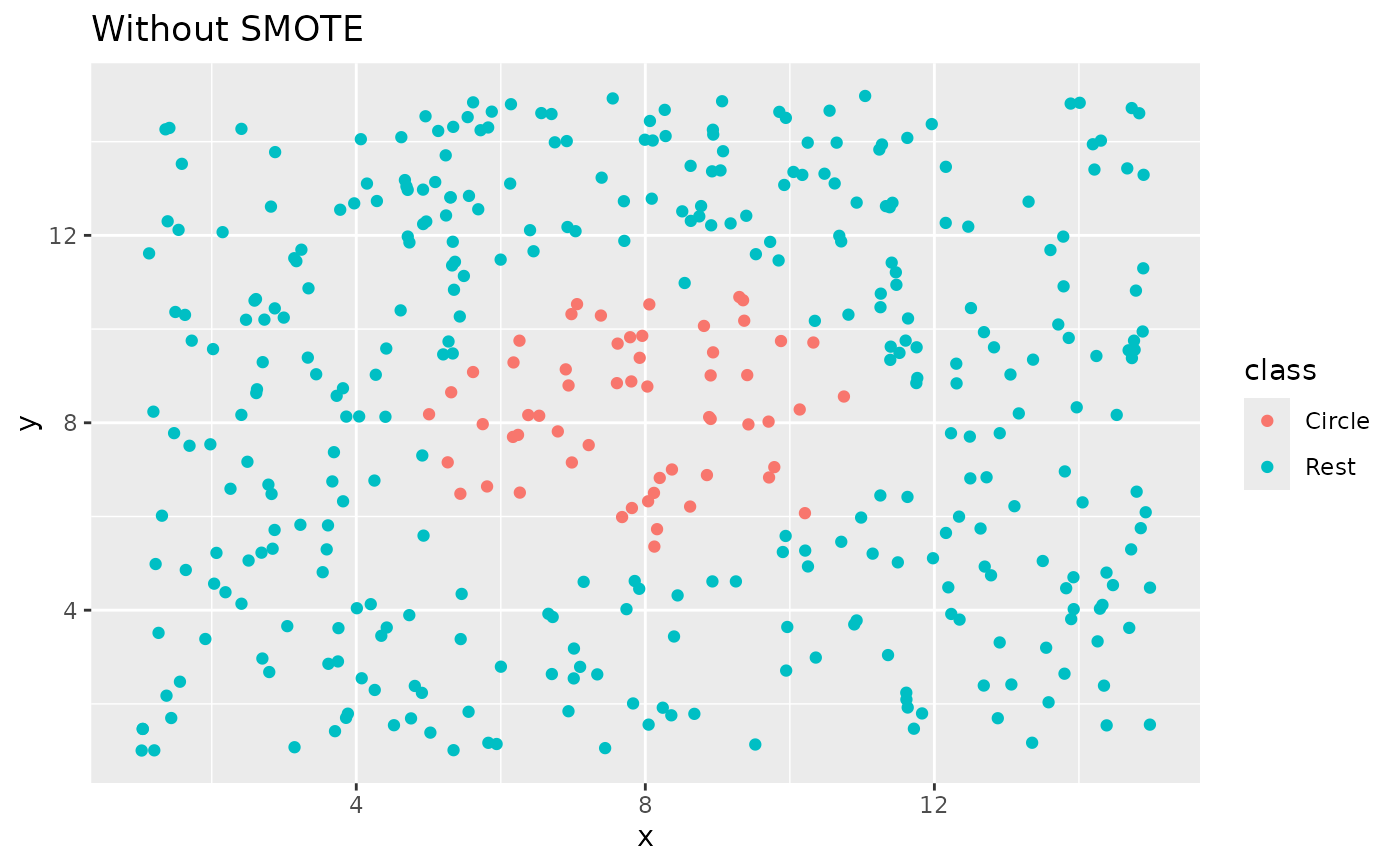
ggplot(circle_example, aes(x, y, color = class)) +
geom_point() +
labs(title = "Without SMOTE")
 recipe(class ~ x + y, data = circle_example) |>
step_svmsmote(class) |>
prep() |>
bake(new_data = NULL) |>
ggplot(aes(x, y, color = class)) +
geom_point() +
labs(title = "With SVM-SMOTE")
recipe(class ~ x + y, data = circle_example) |>
step_svmsmote(class) |>
prep() |>
bake(new_data = NULL) |>
ggplot(aes(x, y, color = class)) +
geom_point() +
labs(title = "With SVM-SMOTE")